 For archaeologists and archaeologists, almost from the very beginning of their discipline, the pottery has been the backbone to "recognize" past societies. Is supposed to be an "idiosyncratic element" of society, ie, an element that identifies a company and, consequently, different from others. This form of recognition to companies, has received serious discussions. However, in the current state of development of archaeological science, still remains a basic methodological tool to start the definition of what a society without writing, such as Andean societies. The area of \u200b\u200bour study, therefore, share the characteristics of the state of development of archeology above.
 So, in the Mala valley is related to a particular society with a way of making pottery or "style." The pottery style that is predominant in the Mala River Valley is the "Vieux Port" and that belong to the local society before the arrival of the Incas around 1470 years of our era. This ceramic style was defined by the archaeologist Duccio Bonavia in 1958, by analyzing a sample of surface sherds collected at the site of the same name (now destroyed) in Chilca near the coastline, about 15 miles approximately north of the mouth of the valley of Mala. This ceramic is mainly characterized by the vessels known as "Face-neck" (see picture above) and ceramics "black on white" (as shown in the photo at left). Vessels predominantly orange paste (baking oxidizing atmosphere) and geometric decoration on the surface. There is also a more rustic ceramic dishes that belonged to the home and from which it has not been given more attention.
archaeological dig in the only published to date and held at the site of Cerro Salazar (Gabe 2000. Tantaleán Although recognized in 1995), located south of the mouth of the valley occurred owned ceramic styles from the Early Intermediate (Style "Lima", "Nasca") until the Late Intermediate. In our tours inside the Valley have not found the presence of earlier styles that found in the Late Intermediate Period, but personal communications with Rommel Angeles relate the presence in the valley of Mala ceramic style akin to the "Hill gold "of the Middle Horizon. However, should clarify whether this is in domestic contexts to raise a population consisting of the Mala valley during this time. Pots
face-neck "similar to those recognized in the Mala valley have been found as far away and San Lorenzo Island (Isla 1995), Pueblo Viejo (Lurin) (Makowski and Vega Centeno 2004), Armatambo (Hyslop and Mujica 1992) and in the cemeteries of Ancon (as the vessel which we found in deposits in the photo MNAAHP below). Therefore, some authors argue that Puerto Viejo style would be only part Ychma style (eg Field Bazán Narváez 1992 or 2005) and even has been called "Ychma Scenery" (Vallejo 2005). However, regardless of artifactual occurrences mentioned above, most of these approaches have not specified:
(1) the amount of ceramic style course Puerto Viejo versus other styles found in similar areas
(2) the archaeological context (whether domestic or funeral) that were found and
(3) whether these artifacts were found dealing directly with Late Intermediate occupation or re-occupation Shiite Inca concerned.
 We, by contrast, argue that the style is different Ychma and is produced in the Mala valley based on the following arguments summarized here (some of them, as suggested by the prospecting of the valley by Williams and Merino (1974) and Engel (1982)):
1. The direct association of this style sherds and settlements of the Late Intermediate.
2. Existence of fragments defects Puerto old-style cooking at high concentrations associated with both domestic settlements in the coastal and interior valley.
3. Radiocarbon associating domestic settlements of the area between Mala Chilca and ceramic Puerto Viejo during the Late Intermediate (Engel 1982).
4. The quality and quantity of pottery of this style found throughout the valley in different contexts.
5. Its survival of ceramic style during the Inca occupation of the valley
6. Subtle features in the shape and decoration of the vessels, mainly face-necks, which differentiates them from others in the central coast area.
7. Finally, one can observe petroglyphs (average trough Cochineros Mala) with designs related to ceramics Puerto Viejo.
Today, we are analyzing samples of pottery collected from the eponymous site (almost destroyed now) that will reveal more meaningful information to define the characteristics of this style. In fact, we are focusing on the relationship between domestic settlements and production / consumption of ceramic Puerto Viejo as a way of establishing meaningful social correlations. In that sense the site of La Ensenada (see below) is a good example of such a secure association between ceramics and local population.
LA ENSENADA
 Also known by the researcher Frederic Engel as "Identified Stone" is an extensive site divided by the Pan American Highway (near the km 82) near the beach of the same name in the mouth of the valley area Bad River a few miles south, also known Kicker beach. This site was described by one of us in 1996 when it announced its accelerated destruction by a housing that today has been consolidated and destroyed much of the eastern section of the site. Also, at present, the west is owned by the company Cementos Lima, where in the '70s of the century Engel had dug past some domestic structures (picture below) and highlighted the intense occupation of the site, mainly during the Late Intermediate Period (1110-1470 years of our era).
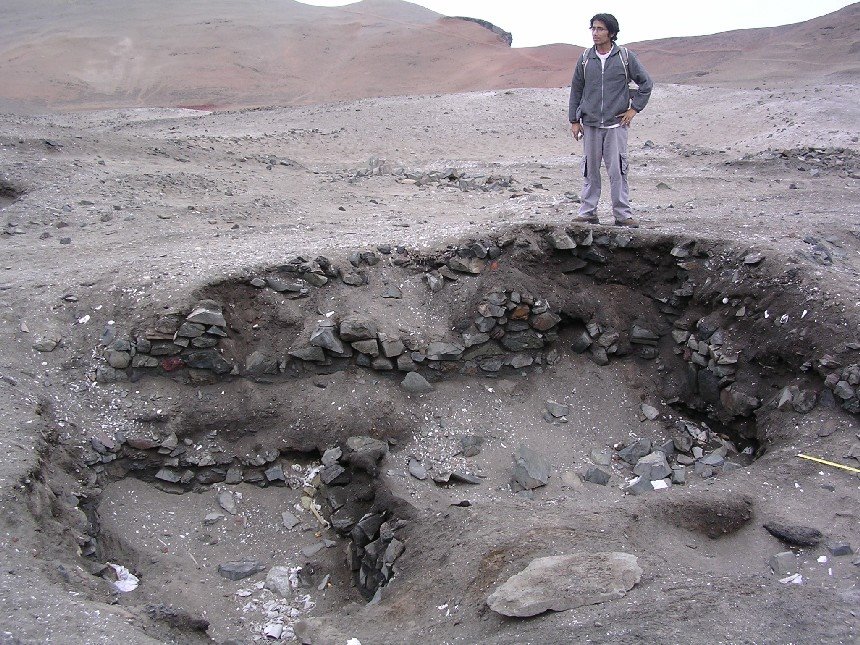 this site also was visited by Charles Williams and Paco Merino in 1976 when performing their archaeological catastrophe, recording its architectural and ceramic surface, closely linked to the Puerto Viejo ceramic style, and reaffirming the position of the connection that Engel this site would have been producing ceramics, question can also be inferred from our recent discovery of clay sources surrounding the site.
 As mentioned, currently much of the site was destroyed by the process of urbanization without the obviousness of prehistoric occupation (and their numerous references in archaeological texts), including structures with volumes rising above the natural surface area, is been an impediment to a modern occupation of the place by the consent of any archeology @ s @ s that have even conducted surveys as part of Archaeological Assessment Project to "prove" their chronological position and power of prehistoric human occupation.


